
My very first volunteering experience took me to an island in the Mekong River in southern Laos. The place isn’t exactly a school; rather, it’s an opportunity for the children of the island to learn some English after school. This is exactly what Phonephet, the founder and host of the project, had in mind when building this place, he wanted to give the children the opportunity to learn better English so that they would have more and better opporunities in the future.
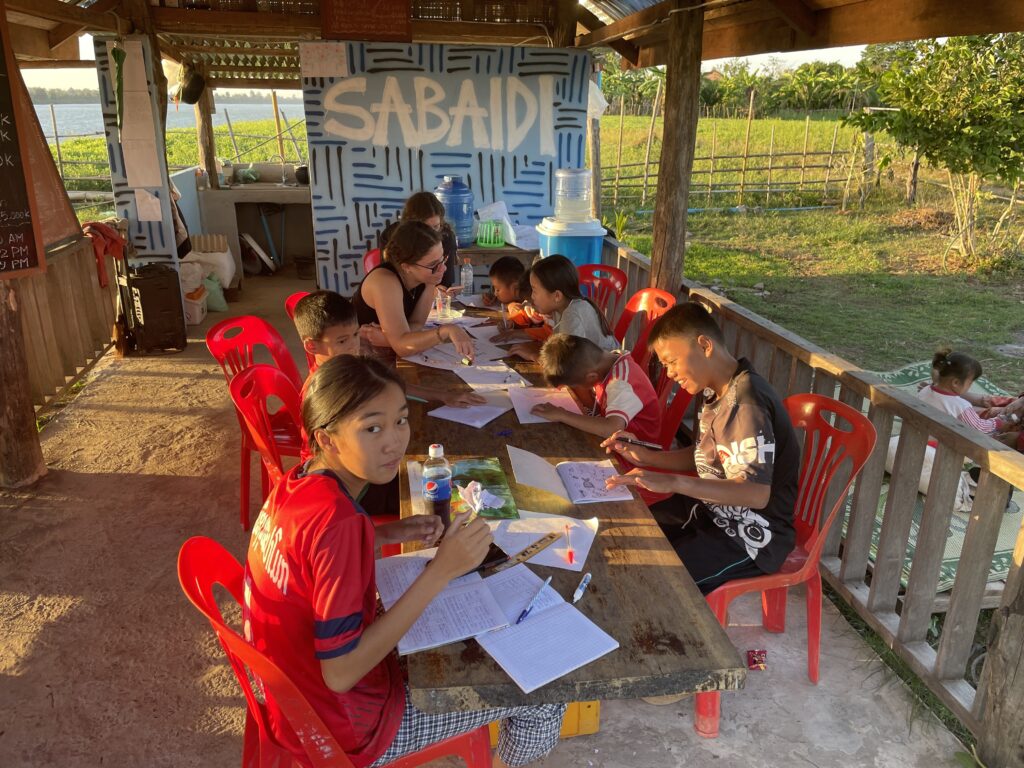
When volunteers are present, the kids can come and practice English with them. There’s a table and a few chairs under a pergola to provide some shade, but there are no classrooms, no whiteboards, and you are far from structured classes.
Planning a proper lesson in this setting is quite challenging, if not impossible. You never know which students will show up, and you’ll have children with varying levels of English, all needing your attention. Creating a syllabus and following a term goal is even less feasible.
Despite these challenges, I believe this project benefits the children on the island. They gain motivation to learn English as they attempt to communicate with the volunteers, and they are eager to learn. Even simple words like “table” and “tree,” the colors or body parts, are valuable lessons for them, as they get to hear properly pronounced English.
I remember one morning walking around the island. I passed through three villages, and everywhere I went, I encountered children who were excited to meet and greet me. Some even joined me for a swim in the river, showing me the best spots to jump in and get out again.
When I returned to the school just in time for lunch, I noticed a large group of children following me at a distance. This was four hours before the official start of the English lesson, yet the children watched us eat and were clearly waiting to play, talk, and learn English from us.
As soon as we finished our meal, we were surrounded by children shaking hands, giving high-fives, saying hello, and repeating the standard phrases, “What’s your name?” and “How are you?”
After a while, the girls began drawing and naming animals with my female co-volunteer, while the boys and I started constructing additional shade next to the pergola. As we experimented with different ways to secure the awning, the kids pointed to various objects, asking me to name them and their colors, repeating those words enthusiastically.
They quickly gave up on teaching me the Laotian terms though, because I struggled to pronounce or remember them.
The afternoon passed swiftly as we built another table, admired the girls’ drawings, folded paper planes, adjusted the awning as the sun moved, and played games. By the time the English class was supposed to start, more children flocked in and simply joined in on our activities. Soon, the sun began to set, signaling it was time for the children to go home before it would get dark.
At dinner, Phonephet remarked that we had a long afternoon with the children and they clearly had enjoyed themselves. However, he recommended that we’d conduct a more structured lesson the next day.
We discussed this late into the night, explaining to him that the children would learn much more from such an interactive afternoon than from a traditional teacher-centered lesson.
My takeaway
Looking back on this first volunteering experience, I understood how powerful it can be to simply show up. Even without classrooms, lesson plans, or clear learning goals, the children gained so much from having volunteers around. We gave them a reason to be curious, a reason to try, and someone who genuinely wanted to listen. English stopped being just a school subject and became a way to connect with another human being.
What touched me most was the children’s joy. Every new word they pronounced, every question they bravely asked, was met with laughter, pride, and shining eyes. These moments may seem small, but they matter deeply. The positive experience would profoundly confirm their efforts and motivate them to learn more.
Even when they didn’t understand everything we said, hearing English spoken naturally helped them develop a feel for the language — something no textbook can replace.
That long afternoon under the pergola showed me that volunteering doesn’t require perfection or special qualifications. Learning happened while drawing, building, playing, and simply spending time together. What the children needed most was attention, encouragement, and human connection — and what I discovered was that giving these simple things can leave a lasting mark on both sides.
Sometimes, all it takes to change a child’s world, is the decision to be there.
Sebastian
The reaction of Phonephet and the following discussions only gave me a first glimpse of the status of teaching techniques and the mindset about education and learning in Asia.
My second and third experience in Cambodia would reveal a lot more insights on this topic and also teach me a lot on how to make an even deeper impact.
However, I think with our example and our discussion, we planted a seed inside Phonephets mind.
Thank you for reading



Leave a Reply